This soup is easy to get excited about as it is delicious, satisfying, comforting, and beautiful–but it’s also, thanks to the lentils, kinda meaty. When you’re eating this, it really doesn’t seem like a vegetable-based soup. Garnish with thinly sliced mint.
2 tablespoons butter
1 large yellow onion, diced
1 teaspoon kosher salt, or more to taste
3 tablespoons tomato paste, or more to taste
4 cloves garlic, crushed
2 teaspoons ground cumin
⅛ teaspoon cayenne pepper
1 quart chicken broth
1 cup red lentils
1 rib celery, diced
1 large carrot, diced
For the Lemon-Mint Yogurt:
6 leaves fresh mint, thinly sliced
1 pinch salt
½ teaspoon lemon zest
½ lemon, juiced
3 tablespoons plain Greek yogurt, or more to taste
Step 1
Melt butter in a saucepan over medium-high heat. Add onion, salt, and tomato paste. Cook, stirring often, until the onion softens and the tomato paste turns a deep brick red or brown color, 5 to 7 minutes.
Step 2
Add garlic, cumin, and cayenne; cook, stirring, for 2 more minutes. Stir in the broth and bring to a simmer. Reduce heat to medium-low and add the lentils, celery, and carrots.
Step 3
Stir and bring to a simmer. Cook, stirring occasionally, until the lentils and vegetables are very tender, 30 to 40 minutes.
Step 4
Meanwhile, grind the mint and salt into a paste using a mortar and pestle. Add lemon zest, lemon juice, and yogurt, and stir together until combined. Refrigerate until ready to serve.
Step 5
Taste the soup and adjust
seasoning as needed. Serve as-is or use an immersion blender to puree
about half of the soup to achieve a creamier texture. Serve hot with
spoonfuls of the lemon-mint yogurt.
300 g vegokött, till exempel Anamma, Vegme eller (som här) Oumphbitar. Det går också att använda knaperstekt ostronskivling eller tofu för den som inte gillar vegokött.
1 gul lök
200 g skogschampinjoner
1 stor klyfta vitlök
1/2 dl rödvin
1/2 tsk dillfrön
1 msk tomatpuré
2 msk dijonsenap
2 dl havregrädde
2 dl vatten
1/2 msk mörk sojasås
1 msk mörk grönsaksfond (eller svampfond
1 dl hackad bladpersilja (+stjälkar)
Juice från 1/3 citron
Salt och peppar
GÖR SÅ HÄR
Börja med att skala och hacka lök och vitlök. Skär svampen i klyftor eller halvor beroende på storlek, och skär gärna ner stjälkarna från persiljan också
Fräs lök, vitlök, persiljestjälkar och champinjoner i rapsolja i en stekpanna eller gryta tills löken är mjuk och svampen börjar ta färg
Tillsätt vegokött, tomatpuré, dillfrön och dijonsenap och fräs i någon minut så det börjar dofta gott. Slå då i rödvinet och låt det puttra på hög värme i någon minut så pannan deglaceras och allt kokar ihop.
Ha därefter i grädde, vatten, sojasås, fond och peppar och låt koka i 10-15 minuter
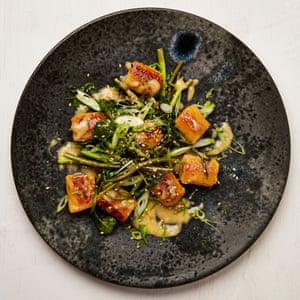
This Asian twist on an Italian classic is so delicious, it is well worth the effort involved. I use a piping bag to get the gnocchi into the boiling water, because that saves on time and effort in shaping them. Serve as a first course.
Swede gnocchi with miso butter and morning glory.
Prep 15 min Cook 1 hr 45 min Chill 1 hr 20 min Serves 6
400g maris piper potatoes (ie, 1-2) 2-3 small swedes, peeled and cut into roughly 2cm cubes (600g net weight) 60ml olive oil 1 egg yolk Salt 155g ‘00’ pasta flour 500ml chicken stock 200g morning glory, or baby spinach 1 tbsp white miso paste 1 lime – zest finely grated, to get 1 tsp, then juiced, to get 2 tsp 2cm piece ginger, peeled and grated 50g unsalted butter, cut into 1½ cm cubes 2 spring onions, trimmed and thinly sliced 1 tsp white sesame seeds, toasted
Heat the oven to 240C (220C fan)/465F/gas 9. Wrap each potato in foil and bake for an hour, or until cooked through. Peel the potatoes while they’re still warm (discard the skins), then mash into a bowl with a potato ricer or masher – you should end up with 230g of smooth mash.
When the potatoes are in the oven, put the diced swede on an oven tray lined with baking paper. Toss in half a tablespoon of olive oil, cover with foil and bake alongside the potatoes for 30 minutes, or until cooked through. Transfer to a food processor, add two tablespoons of oil and blitz smooth, scraping down the sides of the bowl as you go – you should end up with 320g of mashed swede. Put the swedes in the same bowl as the potatoes, then mix in the egg yolk and a quarter-teaspoon of salt. Fold in the flour until there are no lumps, then transfer to a piping bag and refrigerate for an hour.
Snip the end of the bag to make a 2cm-wide opening. Bring a litre and a half of water to a boil in a medium pan, add two teaspoons of salt, then turn down to a simmer. Cook the gnocchi in about five batches, so as not to overcrowd the pan. Pipe 3cm pieces of the gnocchi mix into the water, using a small, sharp knife quickly to release them into the water. Cook for two to three minutes, or until they float to the top, then lift out with a slotted spoon and transfer to an oven tray lined with baking paper, spacing the gnocchi well apart.
Once all the gnocchi are cooked, drizzle over two teaspoons of oil and refrigerate for 20 minutes, until slightly chilled; this will help them keep their shape when they’re fried.
Bring the stock to a boil in a large saute pan, and cook down for 10-12 minutes, until reduced to 200ml. Blanch the morning glory in the hot stock for two minutes, until tender, then lift out with a slotted spoon and roughly cut into halves (skip this step if using spinach; add that raw to the pan later). Return the pan to a medium heat and whisk in the miso, lime juice, ginger and butter, and cook, whisking, for three minutes, until the butter melts and the sauce is smooth and slightly thickened. Do not let it boil or it will split.
Heat the remaining tablespoon and a half of oil in a large frying pan on a medium-high heat. Once very hot, add half the gnocchi and fry for a minute or two on each side, until nicely browned. Transfer to a plate and repeat with the remaining gnocchi.
Put the gnocchi and morning glory (or raw spinach) in the pan with the miso sauce and gently heat through for a minute (if using spinach, until it has wilted). Divide between four plates, sprinkle with the lime zest, spring onions and sesame seeds, and serve at once.
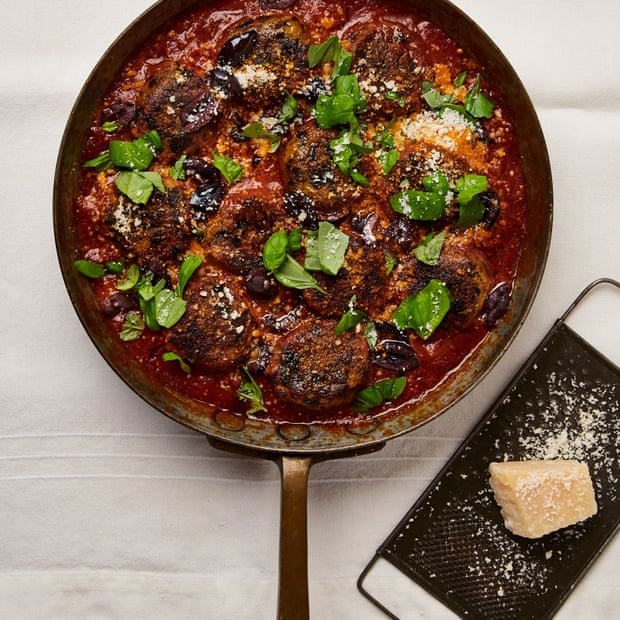
These are like melanzane alla parmigiana in meatball form. They are gloriously rich and cheesy. Some lightly cooked greens would go well with them.
90g fresh breadcrumbs, ideally sourdough (ie, from 2-3 slices) 4 aubergines, cut into roughly 2½cm cubes (1kg net weight) 150ml olive oil Salt and black pepper 100g ricotta 75g parmesan, finely grated, plus extra to serve 2½ tbsp parsley leaves, finely chopped 1 whole egg, plus 1 yolk extra 1½ tbsp plain flour 6 garlic cloves, peeled and crushed 4 tbsp basil leaves, roughly chopped 600g tinned peeled plum tomatoes (ie 1½ 400g tins), blitzed smooth 1½ tsp tomato paste 1½ tsp caster sugar ¼ tsp chilli flakes ¾ tsp paprika 2 tsp fresh oregano leaves, finely chopped 45g pitted kalamata olives, torn in half
Heat the oven to 180C (160C fan)/390F/gas 4. Spread out the breadcrumbs on an oven tray and bake for 12 minutes, until lightly browned and dried out. Remove, leave to cool and turn up the oven to 240C (220C)/465F/gas 9.
On a large oven tray lined with baking paper, toss the aubergines in 75ml oil, half a teaspoon of salt and a good grind of pepper. Spread out on the tray, bake for 30 minutes, tossing once halfway, until golden brown, then chop into a chunky mash and put in a large bowl. Mix in the ricotta, parmesan, parsley, egg, extra yolk, flour, breadcrumbs, a third of the garlic, two and a half tablespoons of basil, a quarter-teaspoon of salt and a good grind of pepper. With lightly oiled hands, shape the mix into 16 golf-ball-sized dumplings, each weighing about 55g, and compress so they hold together.
Heat two tablespoons of oil in a large, nonstick frying pan on a medium-high flame, and fry half the dumplings for three to four minutes, turning them until golden brown all over (adjust the heat if they’re browning too much), then transfer to a plate and repeat with the rest of the dumplings.
Heat the remaining two tablespoons of oil in the same pan, fry the remaining garlic for a minute, until fragrant, then stir in the tomatoes, tomato paste, sugar, chilli, paprika, oregano, a teaspoon of salt and a good grind of pepper, and cook, stirring occasionally, for eight minutes, or until thickened slightly. Pour in 400ml water, bring to a simmer, then lower the heat to medium and simmer for 10 minutes. Add the dumplings and cook for 15 minutes, or until cooked through.
Remove from the heat, scatter over the olives, the last of the basil and a grating of parmesan, and serve straight from the pan.
1 aubergine
1 burk hackade skalade tomater
125g mozzarella
50g riven parmesan
1 vitlöksklyfta
1/2 tsk socker
torkad chili
1/2 knippa basilikablad
olivolja
salt och peppar
Tillagning
Skär auberginen i tunna skivor och stek dem i olivolja i en stekpanna. Låt fettet rinna av ordentligt. Bryn en vitlöksklyfta i olivolja. Tillsätt tomater och koka i 15 minuter. Smaka av med salt, peppar, lite torkad chili och 1/2 tsk socker.
Lägg ett första lager aubergine i en smord, ugnsfast form och täck sedan med ett lager tomatsås. Lägg därefter på ett lager mozzarellaskivor och krydda med salt, basilika samt parmesan. Börja sedan om från början igen och varva ingredienserna på samma sätt. Upprepa tills alla ingredienser är använda och strö till sist över parmesan och basilika.
Gratinera rätten i ugnen på 220°C i 15 minuter.
Kommentar: Bättre att steka aubergineskivorna i grillpanna utan olivolja, alternativt grilla dem på kolgrill.
2 dl sojabönor (kokta) 150g gröna linser (kokta) 1 dl solrosfrön 1 vitlöksklyfta 1 ägg 2 msk fibrex 1 msk dinkelmjöl, fullkorn 1 msk boveteflingor Ca ½ dl vatten Ca 1 msk citronsaft Kryddor: salt, koriander, spiskummin, cayennepeppar, 5 myntablad, några kvistar persilja´(jag hade gärna tagit mer än några kvistar persilja men den tog slut här hemma).
Mixa allt i matberedare, forma till bullar och lägg bullarna på en tallrik. Jag lät sen tallriken stå i kylen ca 10 min, inget måste men så blev det denna gång. Värm upp rapsolja i panna och stek veggibullarna tills de får en härlig knaprig yta.
1 savojkålshuvud
1 purjolök
några potatisar
2 morötter
1 palsternacka
1 gul lök
några vitlöksklyftor
1 röd chili
några msk smör
1 rejäl timjankvist
1 msk salvia
lagerblad
salt
vitpeppar
3 liter vatten
ca 4 dl vita bönor blötlagda över natten eller en burk konserverade som tillsätts mot slutet
Cabbage
salt
hot pepper flakes
fish sauce
sugar
garlic
green onions
carrot
Directions
Cut 2 pounds of cabbage into thin strips about 2-3 inches in length and ¼ inch wide. Place into a large bowl. Add 1 cup cold water and ¼ cup kosher salt. Mix it well with your hands to properly salt the cabbage. Set aside for 10 minutes.
Make kimchi paste by mixing these ingredients in a bowl: 1/3 cup hot pepper flakes, 1 tbs sugar, ¼ cup fish sauce, ¼ cup minced garlic, 3-4 stalks of chopped green onion 1/3 cup worth, ¼ cup’s worth of julienned carrot.
Wash and rinse the salted cabbage in cold water a couple of times. Drain the water.
Mix the kimchi paste into the cabbage thoroughly.Put the kimchi into a container, jar, or plastic bag. Press the top of the kimchi down with your hands to protect your kimchi from being exposed to too much air.
You can eat it right away, just like salad. Or keep it at room temperature and it will ferment in a few days. Fermented kimchi can be used for kimchi stir-fried rice or kimchi stew, and it will be delicious.